Fair-AutoML: Performance-Aware Fairness Repair
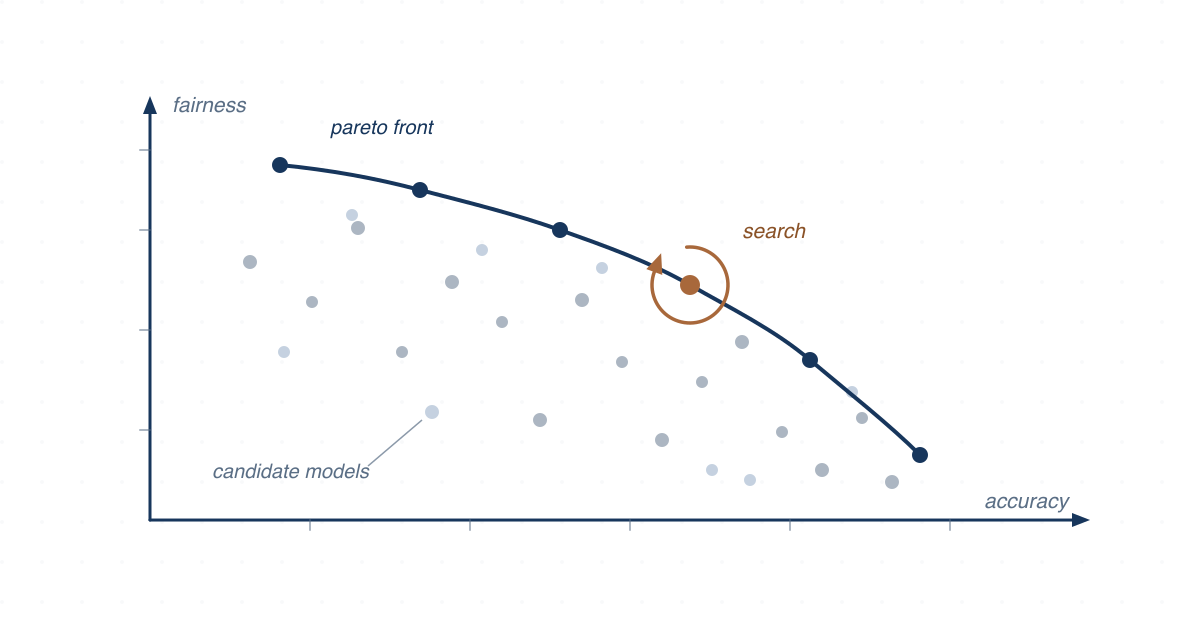
We repaired unfair ML models using AutoML with a fairness-aware optimization function and search space, mitigating bias with little to no loss of accuracy.
People: Sumon Biswas, Giang Nguyen, Hridesh Rajan
Overview
Bias mitigation algorithms typically work only in specific situations and often repair fairness at the cost of large accuracy drops, making them impractical for critical decision-making software. We treated fairness repair as a performance-aware optimization problem: fix the bias in a buggy model without ruining its accuracy.
Fair-AutoML, built on a state-of-the-art AutoML tool, made this concrete through two changes to standard AutoML: an optimization function that incorporates fairness objectives alongside accuracy, and a fairness-aware search space over candidate model configurations. A search-space pruning method further reduced computational cost and repair time.
Key Results
- Fair-AutoML repaired 60 of 64 buggy cases, while existing bias mitigation techniques repaired at most 44 of 64.
- Evaluated on four fairness problems and 16 different ML models, showing significant improvement over the baseline and existing mitigation techniques.
- The fairness-augmented optimization function mitigated bias with little to no loss of accuracy, and fairness-aware search-space pruning cut repair time.
- Published at ESEC/FSE 2023 (“Fix Fairness, Don’t Ruin Accuracy: Performance Aware Fairness Repair using AutoML”).
Related Publications