Long-Term Fairness and ML Safety
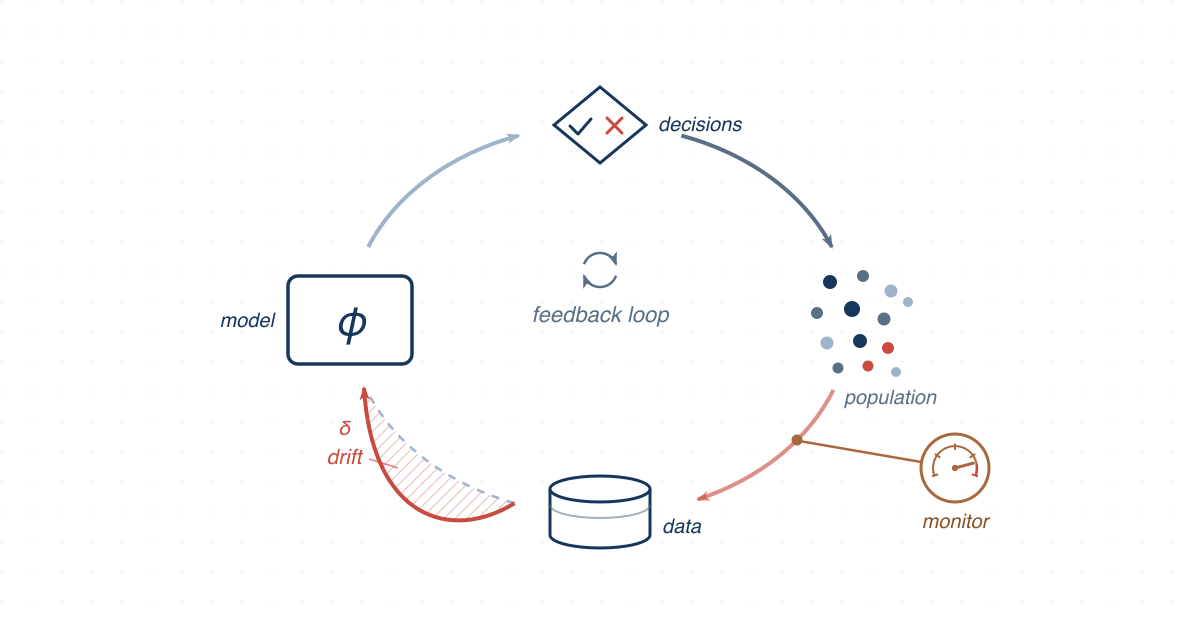
Simulation-based analysis of long-term fairness and safety in ML-enabled systems whose decisions reshape their own future inputs through feedback loops.
People: Sumon Biswas, Yining She, Christian Kästner, Eunsuk Kang
Overview
Many ML-enabled systems operate in dynamic environments: the system’s decisions change the environment, and those changes feed back into its future inputs. Certain self-reinforcing loops can amplify errors, entrench bias, and cause fairness violations in the long term even when immediate outcomes are fair. In predictive policing, for example, a model that flags a neighborhood as high-crime sends more patrols there, producing more recorded arrests, which the model reads as even higher crime. The same pattern appears in loan approvals that affect credit scores and in medical risk scoring that influences treatment access.
We build methods to detect and analyze these long-term risks before deployment. Our FairSense framework (ICSE 2025) performs Monte-Carlo simulation to enumerate evolution traces of a system under a given fairness requirement, then applies sensitivity analysis over the space of configurations to understand how design options and environmental factors shape long-term fairness. This builds on our earlier position that feedback loops should be treated as first-class design concerns in ML-based systems.
Current Focus
- Simulation-based detection of long-term unfairness: given a fairness requirement, FairSense runs Monte-Carlo simulations to enumerate possible evolution traces for each system configuration.
- Sensitivity analysis over the configuration space to pinpoint the small number of design options and environmental factors that most influence a system’s long-term trajectory, enabling targeted monitoring and interventions.
- Case studies in loan lending, opioid risk scoring, and predictive policing, where feedback between decisions and the environment drives fairness violations that static, model-centric evaluation misses.
- Extending the analysis beyond fairness to other evolving system properties, such as safety, whose effects accumulate over time.
Related Publications